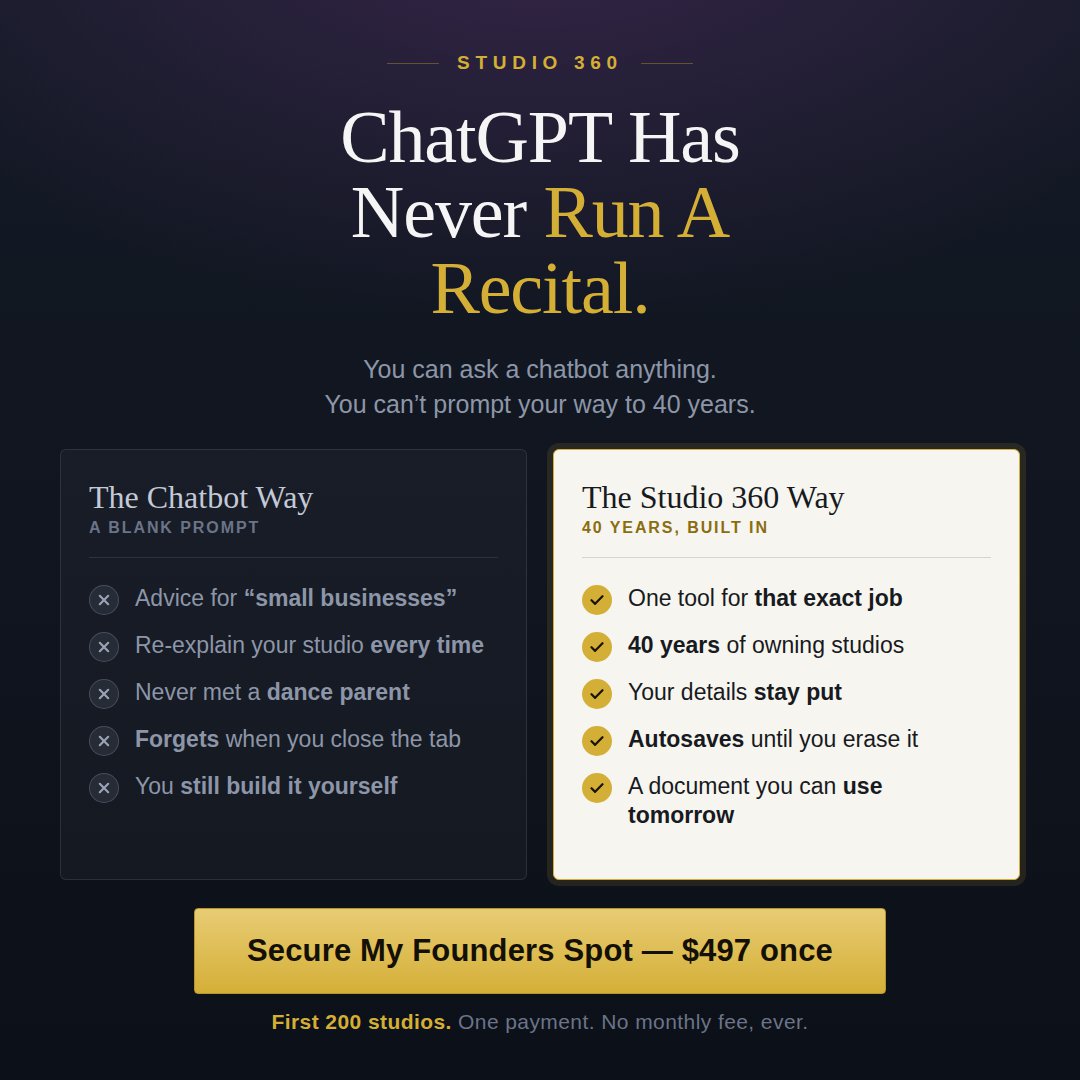
ChatGPT Has Never Run A Recital
What AI actually gets right for your studio — and the four questions it will always answer wrong.
Let's start with the part nobody in this industry wants to say out loud: AI is useful.
We use it. You probably use it. It writes a decent newsletter draft. It cleans up an email you didn't want to write. It'll spit out thirty class name ideas in nine seconds, and four of them won't be terrible.
So no, this isn't the article where two people who've been around for forty years tell you the new thing is garbage. The new thing is not garbage.
But there's a specific moment — and if you own a studio you already know exactly the one we mean — where you type your real problem into that little box, hit enter, read the answer, and think: this person has never been in my building.
That feeling is correct. Here's why.
What a chatbot is actually doing
A chatbot is a very fast, very well-read stranger who has never owned anything.
It has read every business book. It has read a thousand articles about customer retention, staffing, and pricing strategy. It can recombine all of it into a confident paragraph in about four seconds.
What it has never done is unlock the studio at 6am. It has never made payroll on the 15th with three families behind on tuition. It has never stood in the lobby at 8:45 on a Tuesday while a mother explains, in front of six other parents, why her daughter should have gotten the solo.
So when you ask it a studio question, it does the only thing it can do: it answers as though you run a generic small business. Because that's the shape of almost everything it has ever read.
The four questions it will always get wrong
1. Anything with a season attached.
A chatbot doesn't feel September. It doesn't know that a decision made in October is a completely different decision than the same one made in March, because in October you still have the whole year to fix it and in March you're locked in through recital.
Ask it about cutting a class with four students. It'll give you a clean answer about unit economics. It will not mention that those four families each have a sibling in two other classes, that one of them refers you three students a year, and that pulling the class in November means you're having four uncomfortable conversations in a lobby where everyone can hear.
2. Anything involving a dance parent.
This is the big one. AI models a parent as "a customer." A dance parent is not a customer. A dance parent is a customer, a volunteer, a referral source, a critic, a member of a group chat you are not in, and — for about eleven years — part of your community.
The advice "offer a partial refund to preserve goodwill" is technically sound and completely useless if you've ever watched what a single precedent does to the next nine requests.
3. Anything about faculty.
Ask a chatbot how to handle a teacher who's great with the kids and terrible with deadlines. You'll get a performance-management framework. Documented expectations, regular check-ins, a written improvement plan.
Now try running that on a Thursday night with a part-time teacher who's been with you six years, is paid by the class, and is the only person in the building who can handle your Tuesday teen group.
The framework isn't wrong. It's just written for a business with a bench. You don't have a bench.
4. Anything you'll actually be held to.
This is the quiet one. When a chatbot is wrong about your tuition structure, nobody answers for it. There's no name on that advice. There's no one to call in January when enrollment is soft and you're trying to figure out whether the problem was the price, the schedule, or the email you sent in July.
You're the one who answers for it. Every time.
The part that actually costs you
Here's the thing we didn't expect when we started watching how owners use AI.
The bad answers aren't the real cost. You catch most of those. You read it, it smells wrong, you close the tab.
The real cost is the starting over.
Every conversation begins from nothing. You re-explain your schedule. You re-explain your tuition. You re-explain that you have two locations, that your competition team is a separate structure, that your fall registration opens in June. You type all of it out, get a decent answer, close the laptop — and tomorrow that box is blank again and it has never heard of you.
That's not a small annoyance. That's the reason the thing you were going to build in August is still not built in October. Not because it was hard. Because starting was expensive, and you had to pay for it over and over.
What we built instead
Studio 360 came out of a simple question: what if the forty years was already in the tool?
Not as a chat window you have to convince. As ten tools, each built for one specific job a studio owner actually has to do — pricing, hiring, enrollment, student progress, costumes, programs — with the experience already baked into the questions it asks you.
You don't prompt it. You answer it. It asks what it needs because we already know what it needs, because we spent four decades finding out the expensive way.
And then it remembers. Everything autosaves until you erase it. Close the tab, come back in three weeks, it's exactly where you left it, and it still knows your studio.
It doesn't replace your management software. Jackrabbit, Studio Pro, whatever you run — keep it. Studio 360 runs alongside it and handles the part software has never handled: the thinking.
Use both
We're not telling you to stop using AI. Use it. It's genuinely good at the blank-page problem — first drafts, rewording, brainstorming, cleaning up your grammar at 11pm.
Just stop asking it to be a studio owner. It has never been one. It has never had a recital, a parent, a season, or a payroll.
We have. Forty years of them.
That's the difference, and it turns out the difference is the whole job.
Studio 360 is open at the Founders rate — $497 one time, first 200 studios, no monthly fee, ever. Every tool we ship is included at no extra cost.
Secure your Founders spot →