Stop the Chatter: 5 Ways to Reclaim Focus in Your Dance Class
Turning Chatter into Chassés: How to Connect with Today's Dance Students
It’s a familiar scene in studios everywhere: you turn your back for five seconds to cue the music, and suddenly the room sounds like a school cafeteria. When you bring them back to the center, they seem distracted. When you offer a correction, they either take it personally or nod politely—only to do the exact same thing on the next combination.
If you are feeling frustrated, you aren't alone. After 38 years as a dance studio owner, I've seen generations of dancers come and go, and teachers across the industry are echoing the exact same sentiment: the student of today is very different. Today’s dancers are digital natives who are used to constant stimulation, rapid-fire content, and instant gratification. They often bring heightened anxieties and sensitivities into the studio, making the traditional "tough love" approach of past generations of dance training less effective.
To get them to stop talking, focus up, and actually apply corrections, we have to change the way we connect with them. Here are a few strategies to bridge the gap and rebuild a focused, thriving studio culture.
1. Structure the Socialization ⏰
Modern students crave connection with their peers, and if you demand an hour of pin-drop silence, they will inevitably rebel. Instead of fighting the chatter, schedule it.
The "60-Second Share": At the beginning of class or right after a water break, give them one minute to talk to their neighbor. Once the time is up, the rule is strict: voices off, focus on.
Pre-Class Connection: Encourage them to get their socializing out of their systems in the lobby or dressing room before they step onto the marley. Set a clear boundary that the studio door is the threshold for focus.
2. Eliminate Idle Time Through Preparation 🎵
It is a universal truth in the dance studio: idle time is the absolute enemy of focus. If you give teenagers an inch of downtime, they will take a mile of conversation. The most effective way to keep a class quiet is to give them zero opportunity to talk by keeping the pace brisk and unrelenting.
Curate Your Playlists in Advance: The days of scrolling through your phone to find the right track are over. Every second you spend searching for a song is a second you lose their attention. Have your playlists pre-set, downloaded, and ready to play before you even walk through the door.
Plan Your Transitions: Moving from the barre to the center, or splitting the room into groups, are prime moments for chatter to erupt. Treat transitions as part of the lesson plan. Give them exactly ten seconds to move their barres and get to their center marks.
Know Your Choreography Cold: Whether it's a warm-up sequence or an across-the-floor combination, know exactly what you are teaching before you teach it. If you have your combinations locked in, the pace stays brisk. If they are constantly moving and working to keep up with your energy, they simply won't have the breath to chat.
3. Frame the Correction as a Gift 🎁
Today’s students are incredibly sensitive to criticism. When they hear a correction, they often don't hear "fix your alignment"—they hear "you are failing." If a student feels defeated, they will shut down. We have to change the narrative and teach them that a correction isn't a criticism; it's a gift! And after all, who doesn't like a gift!
The Power of "Thank You": As I have written about previously and frequently discuss in my seminars, make it a standard practice that when a student receives a correction, their immediate response must be to look at you and say "Thank You." This simple verbal habit completely alters their mindset. It takes the sting out of the feedback, short-circuits any instinct to get defensive, and puts them in a positive, receptive headspace to take full ownership of the adjustment.
Use "Feed-Forward" Instead of Feedback: Instead of pointing out what they did wrong in the past, frame the correction around what they can achieve in the future. Change "Your prep is wrong, you're dropping your heel when you turn," to "Next time, press that heel firmly into the floor so you can get a higher releve and a cleaner double pirouette."
The "I See You" Approach: Catch them doing something right before you correct what’s wrong. Validation goes a long way with this generation.
4. Make the Learning Interactive 🤝
If you are merely talking at them, they will tune out. Today’s students are used to interactive environments where their opinions matter.
Ask, Don't Just Tell: After demonstrating a combination across the floor, ask, "What is the most challenging transition in this phrase?" or "Where do we need to breathe during this sequence?" Making them articulate the mechanics forces them to mentally engage with the choreography.
Peer-to-Peer Feedback: Have them split into two groups. Group A dances, Group B watches and offers one positive observation and one constructive note. This keeps the observers quiet and focused, and helps them internalize corrections by seeing them on other bodies.
5. Shift the Responsibility to the Student 🧠
Instead of constantly reminding them to focus or nagging them to apply a note, put the ball in their court. Today's teens want agency, so give them the responsibility of taking charge of their own progress. If they aren't applying a correction, have them demonstrate the combination and self-evaluate. Ask, "How did that repetition feel compared to the first one?" or "What do you think you need to adjust to nail that transition?" When they are forced to analyze their own movement and vocalize their goals, they have to stay mentally engaged—leaving no room for distraction.
💡 Pro Tip: The "Stand Tall, Stand Proud" Class Closer 💡
Here is a wonderful way to end the class on a good note while reinforcing ultimate focus. I always make sure we dance hard before we do this—I want their heart rates up, their bodies energized, and their minds engaged.
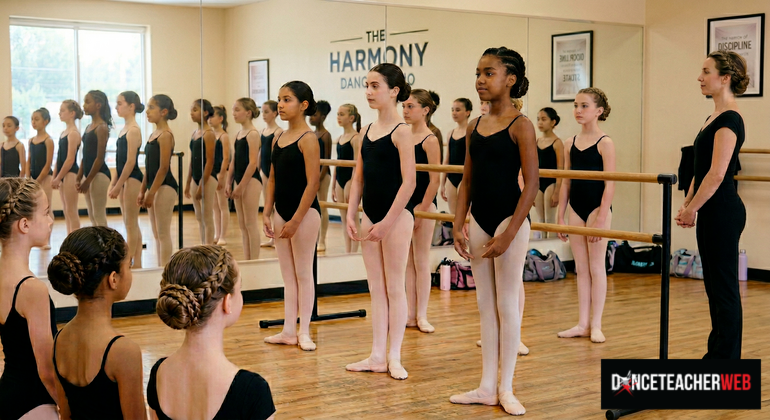
At the end of class, I do an exercise called Stand Tall, Stand Proud. I tell the dancers, "Now I am going to have you do the hardest thing I have asked you to do all class long. Stand still, look straight ahead, and do not move." I do this with students starting at age 8
I explain that it shows amazing maturity and discipline, and it is incredible training for being on stage and having to hold a pose.
Does it work every time? No. Some may even start to laugh and not want to participate. If that happens, I just reset the tone and try again. If one student is the repeat culprit, I will have them sit on the side. The next time we end class with this, they usually get right with the program!
How to execute it:
-
Have them stand tall, shoulders back, chest high and chin up. Feet can be in ballet 1st or parallel jazz 1st, as I like the feet together not apart.
-
Try to hold the room in silence for one minute, and gradually build up to a few minutes.
-
Once we are successfully holding for a few minutes, I will start to talk to them, giving them a few tips or encouraging mindsets.
- While I do this, I keep reminding them: look straight ahead, do not move, and focus on just yourself. * After we are done, I always congratulate them on being able to do this.
🎯 On a side note: if parents are nearby and see this level of discipline at the end of class, they are always very impressed!
The Bottom Line 📝
For today's teenage dancer—who is constantly juggling academic pressure, social media, and everyday anxieties—the studio needs to be a space where they feel seen and respected, not just directed. Shifting from a strict, top-down teaching style to a collaborative one doesn't mean lowering your standards; it means meeting these students where they are. When we validate their feelings, keep the energy high, and reframe our feedback, we aren't just quieting a distracted room. We are empowering our students to take true ownership of their training, build unshakeable confidence, and transform from passive participants into dedicated, focused artists.
Ready to dive deeper into strategies like this? Join us this August 6-9 in Las Vegas for the Dance Teacher Web Conference and Expo to get the tools you need to transform your studio—plus, your registration includes 6 months of free video access to all sessions so you never miss a beat!